
You have shown someone your drawings, listened carefully and come away with a notebook full of comments. The temptation is to change everything at once. A week later, you may have a different portfolio without knowing whether you addressed the original problem.
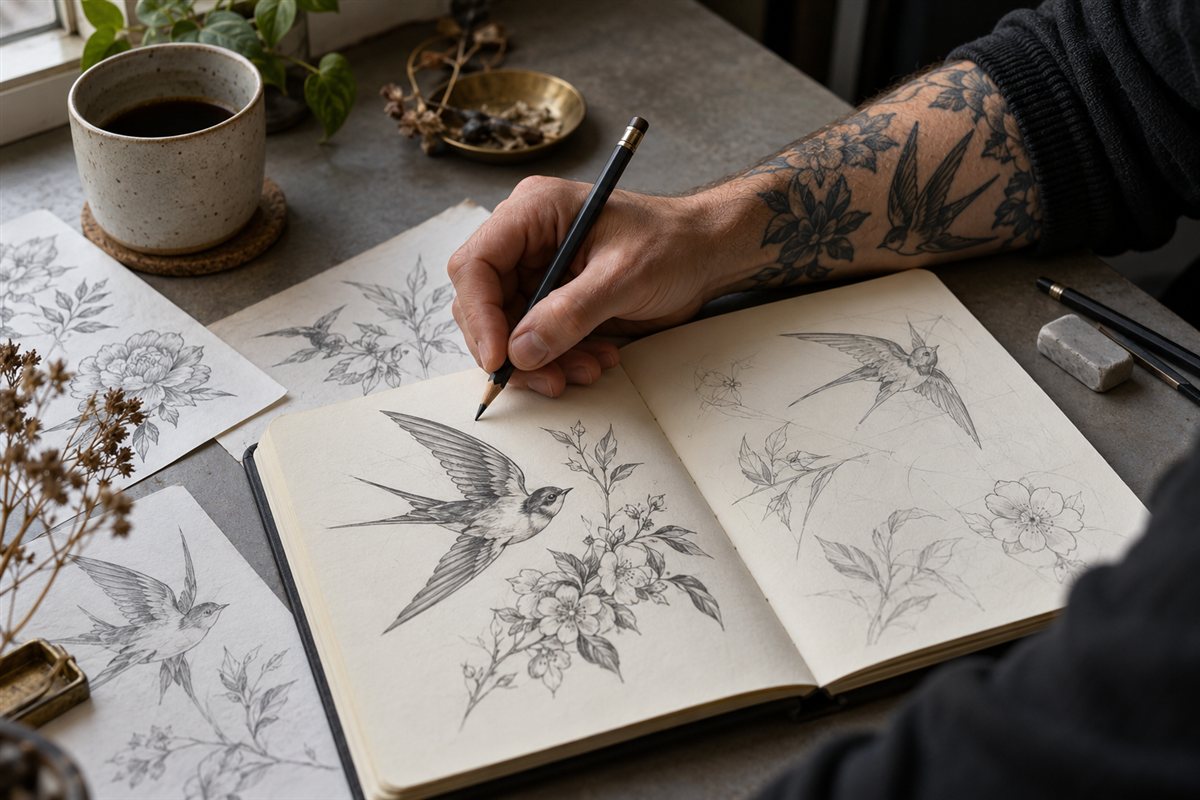
Here is our suggested review exercise: choose one comment, one piece and one revision you can explain. This is an editorial approach to learning from feedback, not a studio admission rule or a promise of an apprenticeship.
Write down what was actually said
Separate the comment from your interpretation. “The centre of this drawing is difficult to read” is a specific observation. “My work is not good enough” is a much broader conclusion, and it gives you little to work on.
If the feedback is vague, write the question it leaves open. Does “more variety” mean different subjects, a wider range of drawing skills or less repetition in the selected pages? You can decide what to investigate without pretending you already know the answer.
Respect the person's availability. If they invited a follow-up, a short, precise question is easier to answer than a request to review the entire portfolio again.
Choose a revision with a visible purpose
Use a piece you own and can revisit. Save the current version before changing it, then write one sentence describing the intended improvement.
| Feedback | A possible experiment | What to compare |
|---|---|---|
| The main shape gets lost | Simplify competing detail around it | Whether the silhouette reads more clearly |
| The series feels repetitive | Replace one piece with work showing a different decision | What the replacement adds to the selection |
| The process is hard to follow | Show a meaningful intermediate version | Whether the change makes sense without a long explanation |
These are examples, not universal corrections. A detailed composition does not always need simplifying, and a consistent series is not automatically repetitive. The useful question is what the particular piece is trying to do.
Change fewer things than you want to
If you alter the subject, composition, medium and colour together, it becomes harder to identify what helped. Keep enough of the original decision intact to make the comparison useful.
For example, redraw the same botanical arrangement with a clearer gap between its main forms before starting an entirely different subject. You can then discuss the gap itself, rather than relying on a general impression that the new page feels better.
This exercise is about drawings. It does not establish how a design will behave on skin or as a healed tattoo, and it is not a reason to practise tattooing on yourself or someone else.
Review the pair, not your memory
Put the earlier and revised versions together at a comparable size. Give yourself a short description task: what changed, why did you change it, and what remains unresolved?
If the answer is only “I spent longer on it”, inspect the work again. Time spent may matter to you, but the viewer needs to see the decision. A small revision with an obvious purpose can be easier to discuss than a polished replacement whose relationship to the feedback is unclear.
Do not force every experiment into the final portfolio. Some revisions teach you something without producing a stronger finished piece. Keep them in your working archive and select what helps the application.
Decide what happens next
End the session with a modest next action. You might repeat the exercise on a second drawing, keep the revision as a process example or return to the original because the experiment weakened it.
Use the portfolio guide when editing the complete presentation. Use the apprenticeship guide for assessing the training arrangement itself. A clearer portfolio helps someone understand your work; it cannot decide whether a studio has the capacity or the right supervision to take you on.