
A useful portfolio makes your own drawing and decision-making easy to assess. Choose work you can explain, show how you developed it and remove pieces that dilute the selection. An expensive folder or a large social following cannot do that work for you.
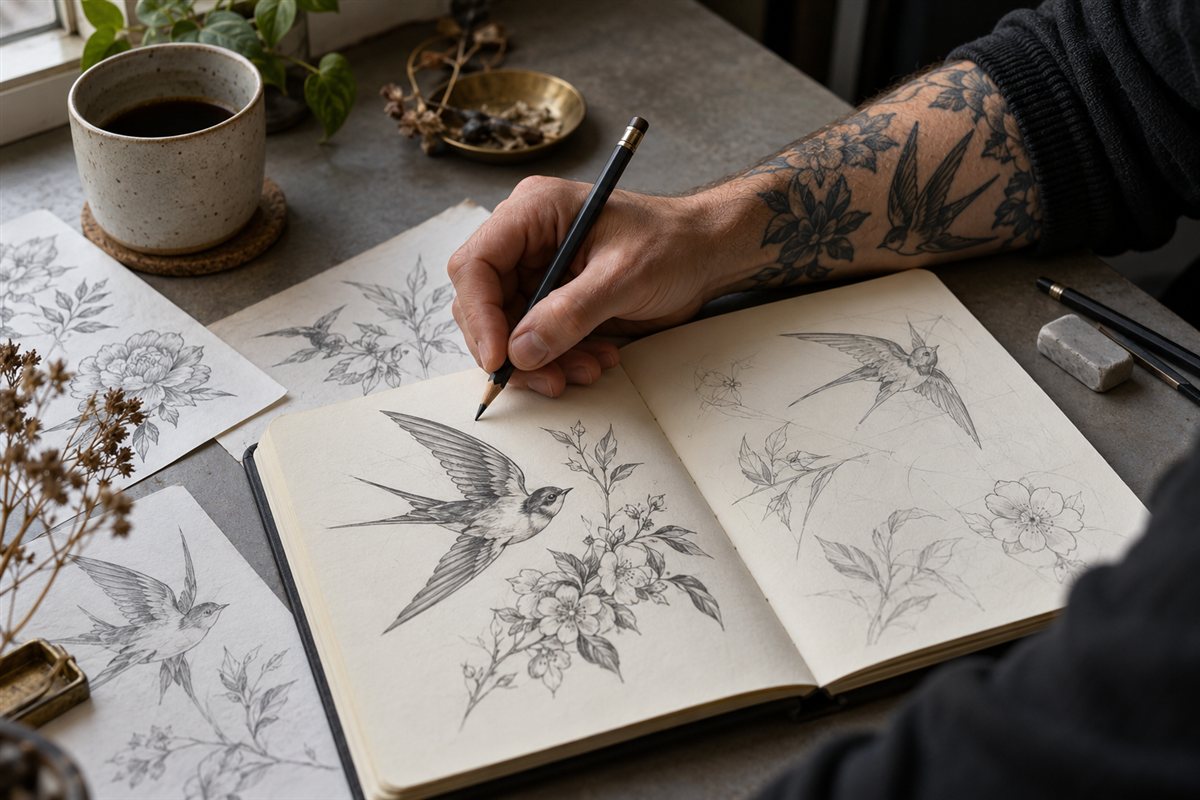
The National Careers Service identifies a portfolio of your own artwork and design ideas as part of the route into tattooing. It does not set a universal number of pages or promise that one style will secure a place. The structure below is an editing method, not an admission requirement.
Give each piece a job
Start by reviewing your existing work before making more. Ask what each piece adds to the selection: observation, composition, line control, tone, colour or a considered response to feedback. You do not need a separate page for every possible technique.
| Type of work | What it can help you explain | What to avoid |
|---|---|---|
| Drawing from observation | How you see shape, proportion and light | Presenting a copied photograph as an observed subject |
| An original finished design | How you organise a complete composition | Filling space with repeated weaker versions |
| A short development sequence | Why you changed the shape, balance or detail | Including every rough sketch without a reason |
| Work revised after feedback | What you noticed and how you responded | Claiming improvement without showing the change |
| A consistent small series | How separate pieces relate without being identical | Padding the portfolio to reach an invented page count |
These are possible ways to show your thinking. Ask the studio about its application requirements before deciding what to include.
Separate practice studies from original designs
Studying an artist's work can help you ask better questions, but it does not make the result your original design. Keep the source and purpose of a study clear. Do not trace another tattoo, remove a signature or describe generated artwork as evidence of your own drawing skill.
The Intellectual Property Office explains that original illustration and photography generally receive copyright protection automatically. An image being easy to find online does not make it available for unrestricted reuse. Its digital-image guidance distinguishes linking to an authorised source from copying and republishing the image.
For a portfolio you plan to share, use your own work and confirm any necessary permissions for third-party material. A credit alone does not automatically grant permission. Keep a private reference note for each piece so you can explain what you created and what you used as a source.
Show one piece developing
Choose a design for which you still have the working stages. Put the initial idea, a useful revision and the finished piece together. Add a short note explaining the decision between them.
For example, you might show that a dense cluster of leaves was simplified so the main silhouette reads more clearly on the page. That explanation is more useful than a long caption saying only that you worked hard. Keep claims about how a drawing would behave as a healed tattoo separate from what you can actually demonstrate on paper.
You are presenting readiness to learn. You do not need photographs of tattoos performed on yourself or another person to show drawing ability.
Sequence for a conversation
Open with a strong piece you are comfortable discussing. Follow it with work that adds something different, then use a development sequence to show how you think. End with another piece that represents your current standard.
Spread the selection on a table or view it as small thumbnails. Look for repeated subjects, sudden drops in finish and pages that need a long excuse before they make sense. Remove or rework those pages rather than assuming more is better.
Keep any labels short: title or subject, medium, date and a brief process note where it helps. Do not invent client commissions, awards or professional experience to make a student portfolio sound established.
Make the digital version easy to read
Photograph flat work in even light, keeping the camera parallel to the page. Check for glare, shadows, cropped edges and distorted proportions. Compare the image with the original before sending it. Avoid filters that disguise the quality or alter the colours you want the studio to assess.
Use clear filenames and a consistent order. If the studio requests a link, test it without being signed into your account and check that it does not expose unrelated personal files. If it asks for an attachment, follow its file and size requirements. Keep original artwork and higher-quality source files separately from the version you send.
A printed presentation should be equally simple: clean pages, a readable order and work that can be handled without loose pieces falling out. There is no need to buy a premium portfolio case before knowing the studio's preferred format.
Prepare for feedback, then revise
Practise explaining a few decisions without narrating every mark. Be ready to identify what still needs work and to ask a specific question, such as which aspect of your drawing would most benefit from further practice.
After feedback, record the point, the action you will take and the piece you will revisit. Keep dated versions so you can see the change. A refusal may reflect the studio's capacity as well as your work; do not treat it as a promise that a particular revision will earn a place.
Use the apprenticeship guide for approaching studios and assessing supervision, pay and training arrangements. This portfolio guide covers the presentation of artwork; it is not permission to practise tattooing.
Sources & further reading
Sources checked .